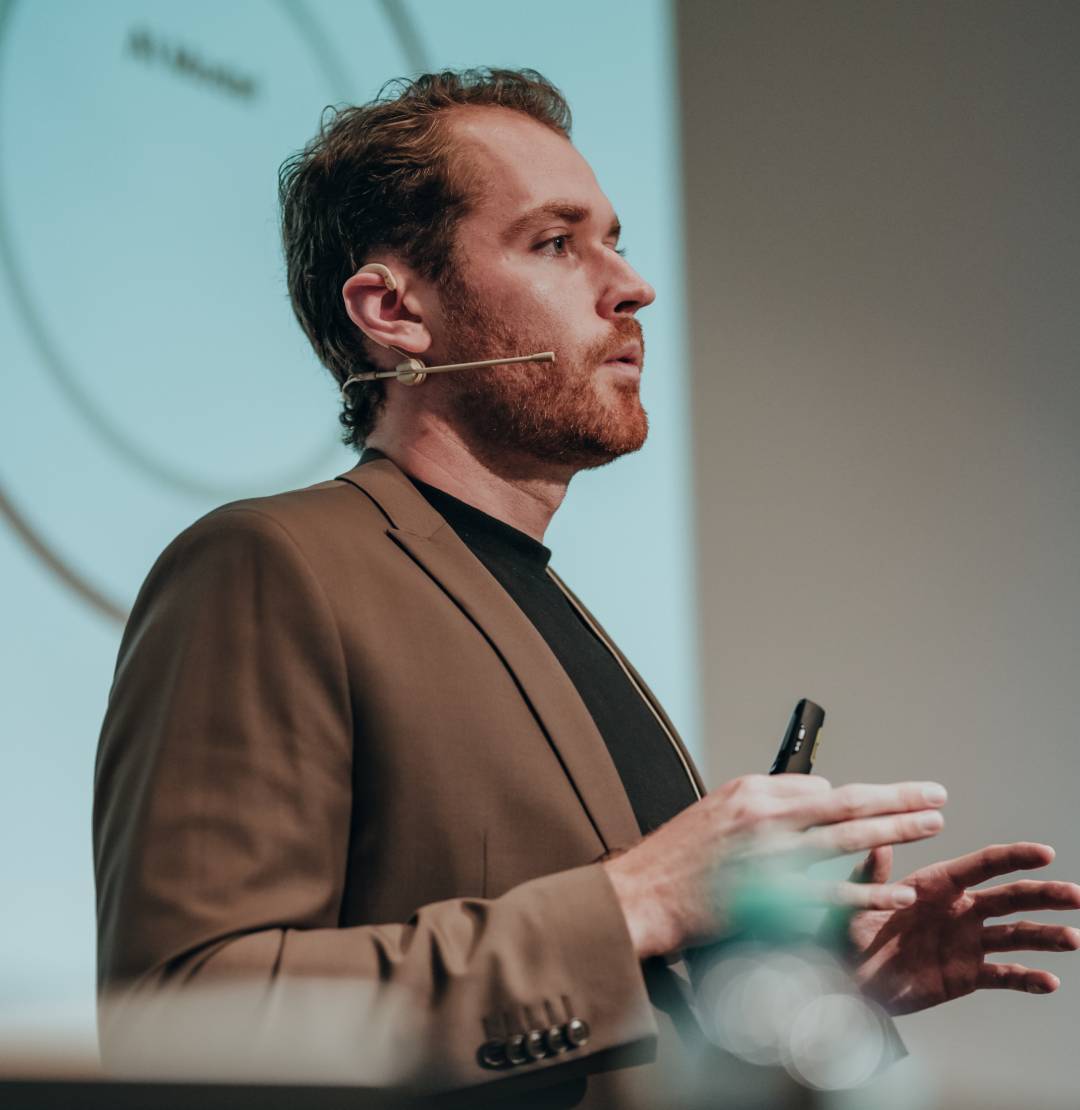
Sebastian Woźniak — Nucleus AI Platform Designer at UBS
Wearing blinders
September 4, 2023
15:45
Future of design
🇵🇱 Polish

3D design is becoming a fundamental part of the design field. A paradigm shift is happening where 3D is becoming more essential to the design process and recent happening within ML is supercharging the creative process of it.
The talk will explore the history of 3D, common misconceptions about what it is, its current status, and how it could impact the future of design. Gábor will share their learnings building a web-based real-time collaborative 3D design tool, and how it introduces a more accessible 3D design process that can scale.
Watch this WaysConf session, then continue with related talks or explore the current programme.
An overview of how browser-based 3D design is moving from specialist production pipelines toward a collaborative design workflow. The talk explains why spatial work feels difficult, traces foundational ideas in interactive computer graphics, and shows how real-time rendering and web technologies expanded what can run in a browser. Product showcases, data visualization, education, storytelling, brand experiences, and spatial interfaces all benefit when 3D adds interaction or understanding rather than decoration alone. Spline is presented as one attempt to reduce handoffs by combining scene creation, materials, responsiveness, logic, collaboration, and web delivery. The broader conclusion is that 2D and 3D are converging, giving designers a larger medium but also a responsibility to use it purposefully.
Spatial design already supports practical work across industries and should add interaction, explanation, or utility rather than decoration alone.
Watch from 1:30A 3D object becomes visible by being projected through a camera onto a flat screen, with light and material shaping the result.
Watch from 3:56Product configuration, data visualization, education, and storytelling benefit when customers can explore rather than only observe.
Watch from 6:54A unified workflow can make iteration easier by keeping scene creation, behavior, collaboration, and delivery in the same environment.
Watch from 9:49Bounding boxes, layered materials, responsive events, components, and direct export lower the conceptual barrier for 2D designers.
Watch from 11:11These concise notes were edited from automatic captions and checked against the talk structure. They are not a verbatim transcript.
Three-dimensional work is often discussed as a fashionable illustration style, yet it already supports architecture, healthcare, maps, entertainment, and many everyday tools. The useful question is not whether an interface looks current because it contains a 3D object. It is whether spatial form makes the product easier to explore, the information easier to understand, or the experience more meaningful.
Watch from 1:04A virtual object exists within coordinates in a scene, but the screen remains flat. A camera defines the viewing angle and projects that spatial information into two dimensions. Lights, shadows, and materials then shape how the object is perceived. This basic model explains both the expressive power of 3D and why designers must manage more variables than in a flat composition.
Watch from 3:56A product model can let customers inspect and configure an item before purchase, while a spatial visualization can express relationships that would be awkward in a flat chart. Playful worlds can also teach difficult topics or make a brand memorable. The strongest cases use depth and interaction to support a goal; they do not ask the audience to navigate complexity without a reason.
Watch from 6:54A conventional web-3D workflow may separate scene creation, export, development, interaction programming, hosting, and later revisions. A small visual adjustment can force the team through the entire chain again. Bringing more of that work into one collaborative environment does not remove the need for technical judgment, but it reduces handoffs and lets design decisions remain editable closer to production.
Watch from 9:49Designers coming from two-dimensional tools already understand bounding boxes, layers, components, and responsive states. Reusing those ideas for movement, materials, screen events, and reusable 3D elements creates a bridge into spatial work. Direct web output and real-time collaboration further connect the medium to ordinary product workflows instead of leaving it inside a specialist production team.
Watch from 11:11