
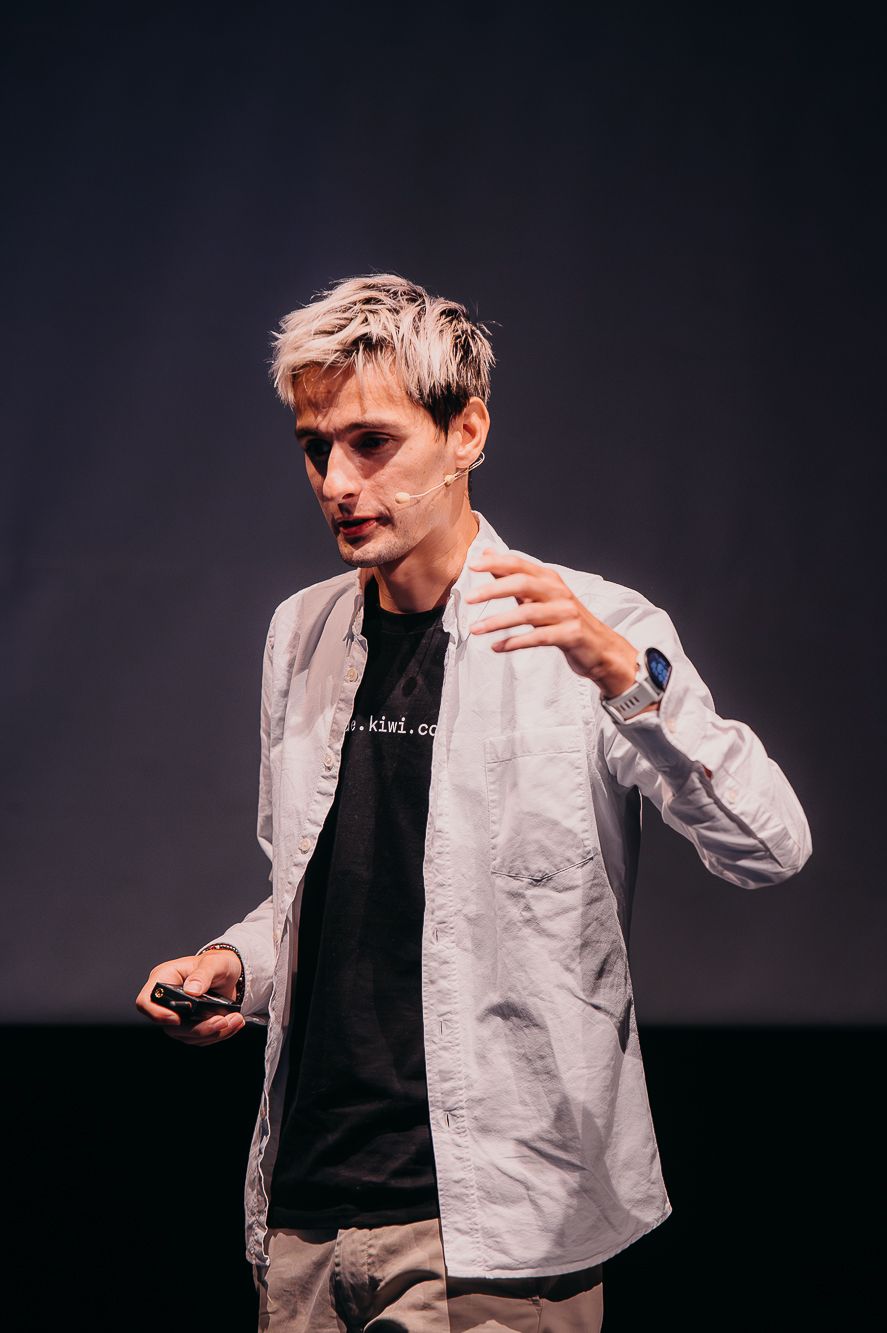
Martin Jancik — Product Design Manager at Kiwi.com
Risking it all. A story on how designers helped rebuild a global company in 6 months.
September 19, 2024
15:55
Planning & Strategy
🇬🇧 English


For the last couple of years I've led the 180° shift in how design has been influencing product strategy all across my company from the top level board investment decisions to department level roadmaps. I'd be keen to talk about this process and how others could incorporate it. There is a really strong aspect of how I went above and beyond just objectives and design visuals and crafted a strong narrative using good storytelling to get the influence we were after. This topic is important because, as a community, I think we know it's not always easy to get design a seat at the table. I want this talk to inspire and encourage designers to utilise their skills, but maybe through a different lens, to achieve influence which is notoriously difficult.
Watch this WaysConf session, then continue with related talks or explore the current programme.
At WaysConf 2024, Miranda Slayter, Principal Designer at Booking.com, details how crafting a compelling, customer-centric story reshaped the company's long-term strategy and aligned over 20,000 employees. Facing a request from executive leadership in March 2022 to deliver a design vision, Slayter avoided past pitfalls of isolated ivory tower visual concepts by establishing a collaborative, cross-functional framework. Engaging over a hundred stakeholders across research, design, engineering, and product, the team synthesized data into prioritized customer promises termed combat statements (Customer Must Be Able To). Instead of delivering a standard bulleted feature presentation, Slayter presented the vision as a relatable traveler narrative following a persona's trip to Paris. The resulting presentation influenced Booking.com's five-year global strategy, annual priorities, and organizational structure. Slayter emphasizes that impactful product visions require broad collaboration, a balance of inspiration with realistic execution, dedicated ownership, and strong storytelling that grounds business capabilities in real human experiences.
Involving cross-functional decision-makers early creates immediate organizational buy-in and ensures vision work does not become an isolated design exercise. Slayter brought over 100 stakeholders from research, copy, engineering, and product together to establish shared priorities.
Watch from 2:27Replacing traditional job-to-be-done statements with Customer Must Be Able To (combat) statements forces teams to articulate clear, binding customer promises. These statements synthesize complex research into prioritized experiences that serve as the foundation for future product roadmaps.
Watch from 4:12Pitching future product concepts through a cohesive user journey engages leadership far more effectively than isolated feature slide decks. Demonstrating how interconnected features solve a traveler's end-to-end trip challenges builds immediate executive enthusiasm.
Watch from 11:53Visionary designs must push product boundaries while remaining technically achievable within three to five years. Grounding futuristic concepts in reality helps employees plot a clear path from current capabilities to the target experience.
Watch from 15:57Product visions fail when treated as side tasks without central ownership. Establishing a dedicated team to maintain a holistic view across business units ensures individual feature roadmaps continuously align with the broader strategic vision.
Watch from 16:59These concise notes were edited from automatic captions and checked against the talk structure. They are not a verbatim transcript.
In March 2022, executive leadership requested a visual design vision to accompany strategic discussions. Previous vision efforts at Booking.com had consumed significant time with little lasting impact, often perceived as isolated exercises created in an ivory tower. To avoid repeating these mistakes, the team took a collaborative approach, bringing together over a hundred stakeholders across research, copywriting, design, product management, engineering, and customer support. Over two and a half weeks, a workshop framework was established to build cross-functional buy-in and ensure the resulting vision directly influenced the company's long-term global priorities and organizational structure.
Watch from 1:42Phase one focused on aligning senior decision-makers around foundational research and customer insights. Instead of evaluating isolated data points or traditional job-to-be-done frameworks, the team structured workshops to evaluate major friction points and delight opportunities through the customer's eyes. This exercise generated prioritized combat statements—short for Customer Must Be Able To statements. These statements defined explicit experience promises that the organization agreed to prioritize in its long-term vision, serving as a binding agreement for future product developments.
Watch from 3:21Once long-term priorities were established, the process shifted to subject matter experts closer to daily product execution. Around fifty stakeholders participated in intensive two-day design sprints to generate specific solutions for each priority area. Designers iterated on high-fidelity interfaces, documenting clearly why each feature mattered and how it benefited travelers. Rather than leaving these concepts as a static deck of features, the team realized that pitching complex connected trips required a unified presentation format that brought the holistic experience to life.
Watch from 5:01A successful product vision relies on three critical foundation pillars: inclusion, realistic aspiration, and dedicated team ownership. Broad cross-functional involvement creates automatic organizational buy-in because participants see how their domain contributes to the larger goals. Additionally, while the vision should push boundaries three to five years into the future, it must remain realistic so employees can chart a practical path forward. Finally, vision initiatives require a dedicated cross-functional team rather than ad-hoc, side-of-desk ownership to maintain a cohesive perspective across the entire business.
Watch from 15:07Responding to audience questions, Slayter explained that the initial vision team did not conduct formal usability validation on the concepts presented to executives. Instead, once leadership approved strategic priorities, individual product departments took ownership of specific vision components to conduct detailed prototyping, user testing, and validation. Slayter also highlighted the intense operational pressures involved, noting that while the original project ran under an aggressive timeline, subsequent departmental vision frameworks at Booking.com have expanded to multi-month initiatives involving up to 250 stakeholders.
Watch from 20:50